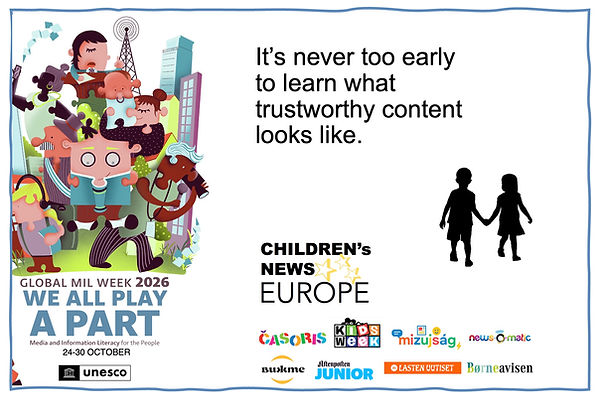
On behalf of their young readers, Children’s News Europe editors got an exclusive chance to ask Adeline Hulin, UNESCO’s head of media and information literacy, some questions for publication during Global Media & Information Literacy Week. The rationale? "We hope these questions will encourage a meaningful conversation about media and information literacy – not only as something children need to learn, but also as something to which they can actively contribute."
We decided the result is enlightening for everyone.

Four questions for an expert
Children and Media Literacy More than just victims?
THE EXPERT
Adeline Hulin works for UNESCO, a team of people whose main goal is to build world peace and safety by encouraging countries to work together. They do this through education, arts, sciences, and culture. Adeline works specifically on a range of media and information literacy projects, and keeps in contact with the young. In the picture below, she’s answering questions at UNESCO’s September 2026 Campus event for teenagers.


THE INTERVIEW
1. Why does news literacy matter – even for adults?
"My parents don't really read the news. They say they get everything they need online, mostly from social media, without paying much attention to where the information comes from. What could I tell them to help them understand why media and information literacy, and news literacy in particular, matter?"
Adeline:
Media and Information Literacy matters to all of us. Not only children, it also matters to teenagers, adults and even our grandparents! Media and Information Literacy is a special thinking skill that helps us question the value of any piece of information we interact with, for example a YouTube video, a newspaper article or a chat with AI.
When your parents were children (ok - that may be hard to imagine!) they got all their information about the world through only a handful of newspapers and television channels. Their information landscape was much more simple and quiet than yours. In 2026 we live in a world that is full of information. We have social media, artificial intelligence, and many voices all trying to catch our attention.
It’s important for all of us to find ways to filter the huge amount of information we receive into manageable information that we can trust and that is true. Similar to having a good diet in our daily lives: we need to focus on having a good diet in our online worlds too: healthy, nourishing facts and truths, not addictive, unhealthy lies or rumours.
Media and Information Literacy skills are skills that we can learn at any age, and they help us to separate fact from opinion, spot misinformation and bias, understand why and how information is produced, and how to use information to make good choices. It’s important that we can find the time to talk to- and teach adults about what we see online and how we figure out whether what we watch and share is reliable or not.
2. Can children help make the internet safer for everyone?
"Adults often talk about how to protect children from the dangers of the internet. But couldn't we, as children and young people, also help make the internet safer and more trustworthy for everyone – including other children, adults, older people and those who may be particularly vulnerable? What could we do?"
Adeline:
Children and young people have an important role to play in making the internet safer - for all of us! And the good news is you don’t need deep technical knowledge or impressive skills to achieve this. With a few tips you can investigate information by yourself, or with friends, classmates or family and then have more control of your digital information spaces.
One of the key things children can do is to simply pause and think before they share more widely: whether that’s a meme, a video, a screenshot, a photo or a snippet of gossip. False information can spread very quickly online so if children and young people can take a beat before believing or sharing, they can stop a false rumour or wrong piece of information from spreading. If false information is like catching a cold, media and information literacy is remembering to cover your mouth when you sneeze!
Also, if a child or young person thinks they have spotted fake news online, most social media platforms have a feature where a child can report a post that seems misleading or hateful.
3. Do young people have to play a part in supporting media and Informtion literacy? If so, how?
Adeline:
Young people have a meaningful part to play in shaping the digital world we share. They need to ask questions, check facts, create trustworthy content, share with care and teach others. That's what Media and Information Literacy is all about.
In my job at UNESCO we see across our work that children and young people are not only passive users of digital technologies, they are creators, entrepreneurs, community builders, and often the ones helping others make sense of a rapidly changing information environment, including AI-generated content.
That is why Media and Information Literacy must be developed with young people, not only for young people. Infact this work is so important to us that we have created a set of guidelines for youth organisations to help guide them here
4. Who is responsible for teaching children about media, journalism and critical thinking?
"Whose responsibility is it according to you to educate our children on Media and Journalism and Critical Thinking? The journalists (we) or the parents or the teachers? Or is it a responsibility carried also by the government or non-profit organisations with youth as target group (Unicef for instance?)"
Adeline:
Between 24 - 31 October, there is a whole week of activities and a global conversation where people talk about and think about Media and Information Literacy and who is responsible for educating children.
It’s called Global Media and Information Literacy Week and happens every year at about this time. There will be over 200 events around the world to celebrate the progress we are making and the work we still need to do!
For 2026, the theme for this week is: “ We All Play a Part: Media and Information Literacy for the People”. It explains that Media Literacy is not just a subject for teachers to teach, but for the whole of society to understand. If the media literacy work is a jigsaw to fit together: each one of us has a part to play: children, parents, teachers, governments, content creators, journalists.
Watch this film to see how our puzzle fits together.